

Tax Invoice Guide: Definition, Requirements & More
Have you ever wondered whether or not your current invoices are legally compliant? If not, your business may be at risk of facing certain challenges. This is where tax invoices come in. A tax invoice is a core financial document for companies, institutions, and individuals, for its role in organizing sales and purchase transactions and ensuring regulatory compliance.
Based on that, it is essential for business owners, accountants, and entrepreneurs to understand the tax invoice meaning, requirements, and components. Read our comprehensive guide on tax invoices to learn about these aspects, the difference between them and regular invoices, how they are issued, and how to pay them via eFAWATEERcom, Jordan’s official online bill payment and management system.
What is a Tax Invoice?
Wondering what’s the meaning of a tax invoice? It is an official financial and regulatory document issued by the supplier upon completing the sale of a taxable good or the provision of a taxable service. It is a legally recognized record that documents commercial transactions and serves as evidence before relevant authorities. As such, it is a key element of the tax system, as it comprises essential details such as the price before tax, the applicable tax rate, and the final total amount paid by the customer, while also ensuring compliance with relevant tax regulations.
In addition, a tax invoice serves as an official record of sale that helps authorities monitor business activities and ensures transparency in financial reporting. It supports companies in maintaining accurate and well-organized accounting records and is used for tax auditing purposes as well as the proper regulation of financial documentation.
After learning the tax invoice definition, here is the information it covers per tax regulations.
Tax Invoice Components: What it Records
Each tax invoice covers essential elements, without which it is not legally valid. As such, these details guarantee that the commercial transaction is clearly and accurately documented while supporting compliance with tax requirements.
Below are the key elements of a tax invoice:
1- Supplier and Customer Names
The names identify the parties involved in the business transaction, whether the sale takes place between a company and a customer or between two business entities.
2- Tax Number
This is the registration number of the business or a tax-registered entity with the Income and Sales Tax Department, which is a key element of any official tax invoice.
3- Issuance Date
This specifies the date on which the invoice was issued, playing a key role in accurately documenting the transaction and ensuring it is correctly linked to the appropriate tax period.
4- Description of Goods or Services
A tax invoice must include a clear description of the sold product or provided service to maintain transparency and accuracy.
5- Price before Tax
Tax invoices list the value of goods or services before the applied tax, serving as the basis for further calculations.
6- Tax Amount
To maintain precision and clarity, the tax invoice shows the value of the added tax according to the legitimate rate as per tax authorities.
7- Total Amount
This refers to the final and payable amount after adding tax to the base price, which is the total that the customer pays.
Tax Invoice Requirements: What Makes It Valid
Tax invoice requirements refer to the conditions and details that make these invoices legally valid and compliant, enabling them to operate fully within the broader tax system.
Below is a clear breakdown of the tax invoice requirements and what they entail:
1- Issued by a Tax-Registered Entity
Tax registration is fundamental for officially recognizing tax invoices. Therefore, they must be issued by a business or individual registered with the Income and Sales Tax Department, or else they are invalid.
2- Includes a Unique, Non-Duplicated Invoice Number
Another key requirement of tax invoices is the identification number; it is a unique, non-duplicated number that enables accurate tracking and prevents tampering with and duplicating financial records. This condition is especially necessary with digitalized and electronic invoicing systems.
3- Contains all Required Details
In order for a tax invoice to be legitimate, it must cover and document all previously mentioned components, such as the supplier and customer names, tax number, description of goods or services, the total amount, and other essential information.
4- Follows Tax Authority Regulations
Tax invoices must be issued according to the Income and Sales Tax Department regulations, dictating their tax invoice format, calculation methods, record-keeping procedures, and other related processes, ensuring full legal compliance.
5- Issued within the Specified Timeframe
Tax invoices must be issued at the time of the transaction or within the time period required by the tax system, recording the sale timely and avoiding regulatory issues caused by delays.
6- Documents Information Accurately
All information listed within the tax invoice must be clear, accurate, and error-free, considering that any minor error or inconsistency can undermine its credibility and potentially cause financial and legal consequences.
How to Create a Tax Invoice: Issuance Process Step-by-Step
Issuing a tax invoice must follow specific steps to achieve compliance with tax regulations and comprehensive documentation of all required components. Below is a clear breakdown of how to create a tax invoice step by step, helping you with valid issuance:
Step 1: Verify Tax Registration
It is essential to validate that the business creating the invoice is registered with the Income and Sales Tax Department and that it has a valid tax identification number. This number legally allows the business or entity to issue official and valid tax invoices, without which they are invalid and cannot serve any official function within the overall tax system.
Step 2: Choose a Suitable Invoicing System
After confirming registration, you need to select the best method for creating tax invoices. You can either proceed with an internal accounting system or approved electronic invoicing systems, such as the national e-invoicing system. Whichever method you choose, it should help streamline the invoicing process and maintain compliance with the official standards.
Step 3: Enter the Tax Invoice Details
At this stage of how to create a tax invoice, you enter all the tax invoice components—the information it must document—to achieve accuracy, clarity, and validity. Some of these details include the supplier and customer names, issuance date, tax number, and a thorough description of the taxable goods or services.
Step 4: Calculate the Price and Applicable Tax
Now, enter the price of each good or service before tax. Then, calculate the applicable tax according to the official, applicable rate. Finally, determine the total amount. This is the core step of how to create a tax invoice, as it produces the actual and precise value of the transaction.
Step 5: Review the Tax Invoice
Carefully review the invoice to ensure there are no errors or inconsistencies in the data or calculations. Any oversight can affect the invoice’s legal validity, potentially leading to internal accounting issues or tax-related challenges.
Step 6: Issue the Invoice and Retain a Copy
Once all details have been verified, you can issue the official tax invoice and deliver it to the customer or recipient. Meanwhile, retain a copy within your internal system or accounting records, since it is essential for various purposes like future auditing and tax compliance and tracking.
What is the Difference between a Tax Invoice and a Regular Invoice?
Tax invoices and regular invoices may appear similar but are quite distinct from one another. The differences between them lie in their purpose, the information they document, and the extent to which they are recognized within accounting and tax systems. While both are used to record the sale of goods or the provision of services, there are important differences that business owners and companies should be aware of.
Here is an overview of the differences between tax invoices and regular invoices:
- Definition
A tax invoice is an official document issued by a tax-registered entity, and it includes details such as the applicable tax to the provided goods or services. In contrast, a standard or regular invoice is a document that confirms a sale or payment without necessarily providing detailed tax information.
- Components
A tax invoice includes the tax identification number, tax amount, pre-tax price, and the final total after tax, along with other basic details. On the other hand, a standard invoice may only include the product or service name and the total price.
- Legal Purpose
A tax invoice is used for tax compliance purposes, financial reporting, and accounting audits. Meanwhile, a standard invoice serves as proof of payment and purchase in day-to-day transactions.
- Issuing Entity
A tax invoice is issued by tax-registered businesses or companies, which are legally required to do so according to the official regulations. However, regular invoices may be issued by entities that are not tax-registered, depending on the recorded activity.
In short, the difference between a tax invoice and a regular invoice is that the former is more formal and comprehensive and is incorporated within the tax system, while regular invoices are simpler and are used for proving financial transactions in general terms.
Paying Invoice Taxes Securely and Quickly through eFAWATEERcom
You can pay your tax invoice in a few moments, securely and easily, through eFAWATEERcom’s portal, Jordan’s official online bill payment and management system. With eFAWATEERcom, there is no need to commute to any branch or wait in line to settle your invoice. Enjoy a simple and flexible way to pay your invoice via eFAWATEERcom, whether you are an individual or a business.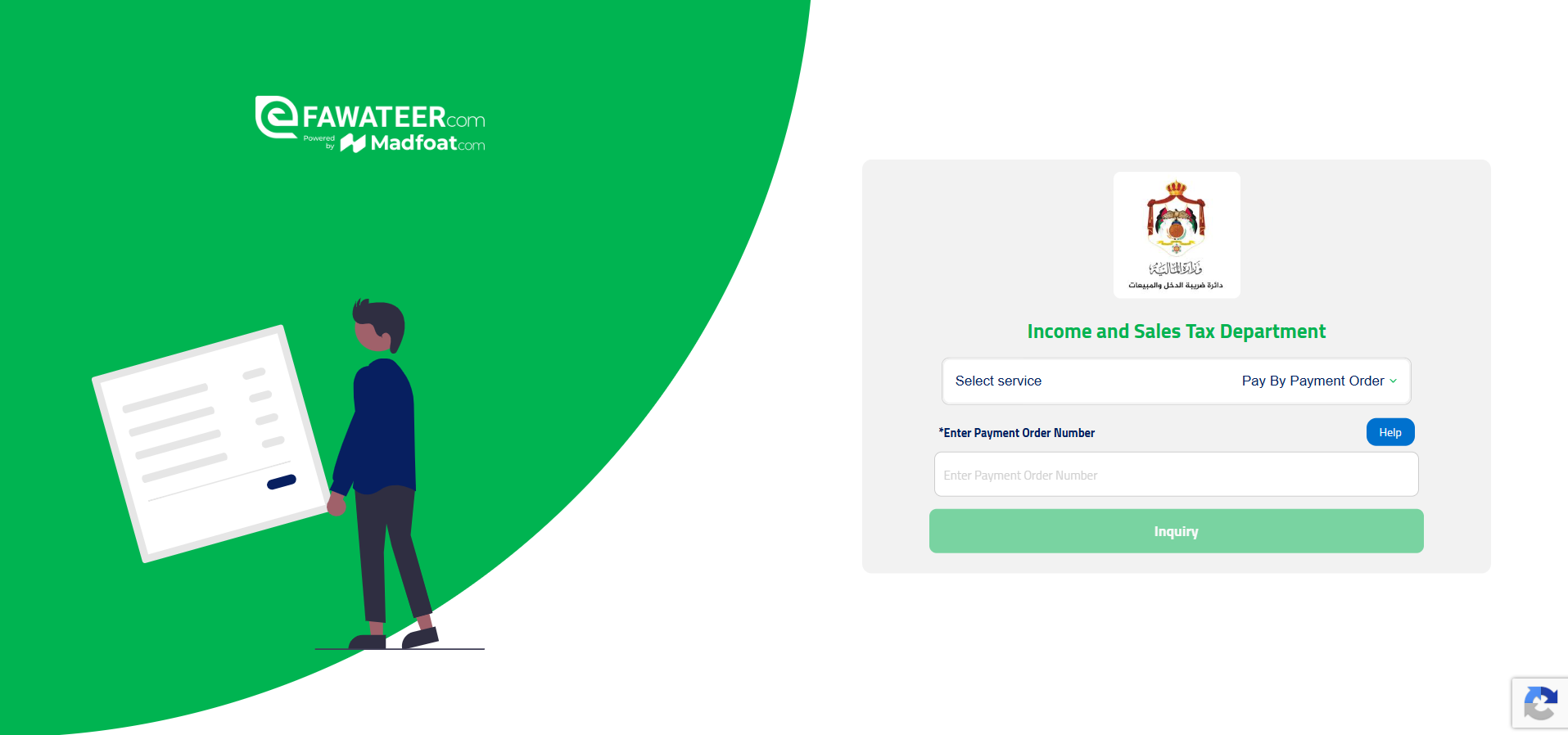
1- Log in to Your Account: After creating an account on eFAWATEERcom’s portal, log in to proceed.
2- Choose the Biller: Choose “Services” from the menu on the left. Then, select “Government Services” and “Income and Sales Tax Department” from the sub-menu.
3- Select the Service: Pick the type of service you want to settle, depending on the owed tax invoice.
4- Enter Payment Details: Enter the Payment Order Number or Tax Payer Number, depending on the service you selected in the previous step, in order for the total amount to show on screen.
5- Complete Payment: Choose the most suitable payment method—credit card, PayPal, or another—then enter your financial information to proceed with payment.
FAQs on Tax Invoices
Here are the most frequently asked questions about tax invoices and their answers:
1- How long should a tax invoice be retained?
It is best to retain tax invoices and other records connected to them for the entire duration specified by tax regulations, enabling future revisions and accounting audits.
2- Is an electronic invoice considered an official tax invoice?
Yes. If the tax invoice is created through an authorized system and includes all legally required details, then it is officially recognized and valid.
3- Can a tax invoice be issued manually, or must it be electronic?
This depends on the business activity and regulations taking effect in the relevant country and sector. In some cases, tax invoice creation can be manual, given that it meets all tax invoice requirements. However, some systems can mandate electronic issuance using authorized systems only.
4- What happens if a tax invoice is not issued at the time of sale?
Failing to create a tax invoice at the time of sale can lead to penalties and fines, in addition to accounting discrepancies and inconsistencies when documenting financial transactions. As such, it is important to comply with the applicable regulations and ensure invoices are issued timely as required.
Compliance with tax invoice regulations goes beyond a routine procedure; it is a key indicator of a company’s professionalism and financial stability.
eFAWATEERcom grants you the easiest and most secure way to pay your tax invoices and other financial obligations online. No complications, no waiting, and no commuting. Because time efficiency matters when paying bills, begin settling and managing your invoices through eFAWATEERcom’s portal to save time and effort, enjoying a convenient paying experience.
Read more: How to Pay University Fees Online through eFAWATEERcom Quickly and Securely